

Five mistakes businesses make when choosing commercial laundry equipment
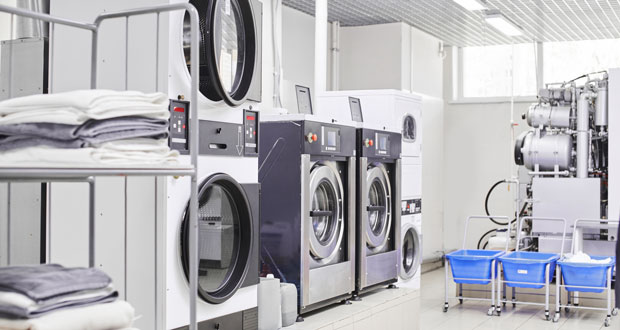
Although you may rely on professional laundry equipment in your day-to-day operations, that doesn’t mean sourcing replacement appliances will be easy. After all, there’s a lot to consider, and plenty of ways to get things wrong.
You might, for example, forget to measure the square footage of your laundry room, or else calculate your capacity requirements incorrectly. Or, you might simply opt for the cheapest model, even if that means compromising in other areas.
In any case, businesses often make mistakes when investing in new equipment for their on-site laundry rooms. So, in this post, we’ll be looking at some of the most common missteps and the solutions that could help you avoid them.
Mistake #1: Not considering the space and layout of your laundry room
Shopping around for new commercial laundry equipment, it’s all too easy to get distracted by the spec sheets, features, and value-add functionality of different appliances. But available square footage is arguably the single most important factor when selecting new equipment, impacting the usability, safety, and general workflow of your laundry operations.
Certainly, selecting appliances with innovative features and advanced technologies is important in levelling up your laundry capabilities. But these nice-to-have functionalities shouldn’t come at the expense of usability, access, and safety.
Note, too, that there’s a hygiene element to all this, particularly in laundry rooms where infection control and contamination prevention are critical. A cramped, poorly designed space makes it significantly more difficult to segregate and control laundry throughput, compromising H&S and potentially putting your compliance at risk.
The solution
Rather than choosing new laundry equipment based on features and functionality, consider the layout and square footage of your laundry space carefully. You may even like to incorporate stacked combination systems to better utilise vertical space.
Mistake #2: Failing to factor in short- and long-term capacity needs
All commercial laundry equipment is rated for specific load capacities, be it 7 kg or 180 kg. This ultimately dictates your per-cycle capacity, so it’s important that the numbers align with your average laundry volumes on a day-by-day basis.
You might assume bigger is better where commercial laundry capacities are concerned, but that’s not necessarily the case. There’s no use in opting for a larger appliance than you need simply for the sake of increasing your throughput; don’t forget that larger washers and dryers will be more expensive to run, service, and maintain, and will take up more space in your laundry room, too.
Often, laundry managers and business owners have only a vague idea of their average daily laundry throughput. And that’s a problem, since it could mean investing in commercial laundry equipment that isn’t a perfect match for your current and future laundry capacity requirements.
The solution
Before choosing new laundry equipment for your business, get a handle on your average capacity needs. There are a few different ways to calculate this, including manually monitoring laundry throughput over a fortnightly period, relying on smart meter energy consumption data, or by reviewing data collected by auditing software within your existing laundry equipment.
Remember, too, that you should account for future business growth and capacity increases when selecting new laundry appliances. You’ll want the headroom to scale up your laundry operations when necessary, without needing to upgrade your equipment all over again.
Mistake #3: Failing to consider installation requirements
A commercial laundry room comprises a handful of powerful technologies, working side by side and in sync. This, of course, requires a careful setup and installation process, not to mention timely ongoing maintenance, servicing, and aftercare.
Go it alone with your commercial laundry equipment upgrade, and there’s a risk that you’ll invest in appliances which are ill-suited and incompatible with your current laundry room infrastructure. Don’t forget that every appliance has unique installation, power, drainage, venting, and placement requirements, so you’ll need to consider installation carefully to ensure a successful deployment with no long-term ill effects.
The solution
Auditing your existing laundry room space is essential prior to any equipment upgrades. That way, you’ll know for certain that you have the service connection points, drainage capabilities, and adequate ventilation infrastructure required to onboard your new appliances successfully, with minimal downtime and disruption.
Of course, opting for professional installation is also highly recommended in the case of commercial laundry equipment. A trained engineer will be able to set your equipment up in such a way that it offers optimal performance, safety, and efficiency right out of the gate, all while reducing the amount of time that your laundry room will be out of action.
Mistake #4: Choosing the most affordable option
Amid the daily pressures of managing your business, opting for the most affordable replacement equipment can seem like a prudent decision. But this will only bring short-term benefit, and could even wind up costing you in the longer term when excess maintenance and repair costs come into play.
In the case of commercial laundry equipment in particular, there’s no real benefit to choosing the most affordable model. Cheaper appliances could prove more expensive to run and require regular maintenance, servicing, and repairs, offsetting any savings you made on the initial purchase price. Plus, they may not have the lifespan of their premium counterparts, meaning you could be seeking another upgrade sooner than you would like.
The good news is that, in the case of professional laundry equipment, most appliances have been built to exacting standards, and comprise durable materials that contribute to longer expected lifespan. So, unlike their domestic counterparts, it is much less likely to get stung by a defective or poor-quality appliance – even if you opt for a cheaper model.
The solution
Always weigh up any purchase decision carefully, ensuring that your investment is part of a long-term strategy, rather than a short-term cost-saving measure. There are a raft of factors to consider when choosing new professional laundry equipment, so the initial purchase price should, realistically, be of medium priority only.
Mistake #5: Miss out on flexible finance solutions
Investing in new laundry equipment can put a significant strain on your operational budget, exposing you to high upfront payments that squeeze your working capital. Certainly, there may be a tax benefit to paying for new equipment outright, but, for many businesses, the high costs associated with new replacement equipment can prove too much of a financial burden.
If you fail to shop around when investing in new laundry equipment for your business, you may miss out on flexible financing solutions that mitigate the high upfront costs associated with buying appliances outright. There are a wide range of financing options available for businesses seeking replacement equipment, and these can make for simpler budgeting and fiscal control.
The solution
Before you invest in new commercial laundry equipment, make sure you’ve looked at all the different financing options available. For instance, it may be possible to get the equipment you need for a fixed monthly cost with no upfront payment required, so this can make ongoing budgeting much simpler, with no initial capital outlay.
Another benefit to financing or leasing new laundry equipment in this way is that installation, servicing, maintenance, and ongoing repairs may be included as standard. This means that should you experience a breakdown, there’ll be no unexpected repair bills to put a dent in your finances.
There’s no one-size-fits-all solution for choosing the right commercial laundry equipment. Every business has unique needs, priorities, and requirements, so you’ll need to weigh up your options carefully, consulting experts where appropriate to ensure you make the right choice.