
How cleaning teams can work more safely and effectively with high-access specialists
 By David Garvey, Operations Manager at Crown Services Organisation
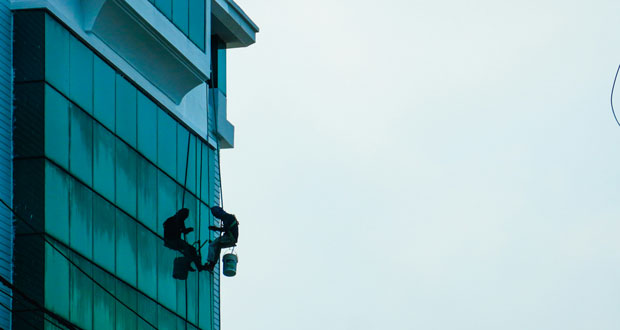
A cleaning team may know exactly how to treat a surface, yet have no safe way of reaching it. A rope access technician can solve that problem, but access alone does not guarantee that the surface will be cleaned correctly.
That gap is often overlooked.
High-level cleaning combines two different areas of judgement. One concerns the material, contamination and required finish. The other covers rigging, positioning and working safely at height. Problems arise when either side is expected to fill in the blanks left by the other.
A brief that says little more than “clean the upper façade” may be enough to request a price, but it is not enough to plan the work properly. The access specialist needs to know what the surface is made from, what has built up on it and what result is expected.
First Ask Whether Specialist Access Is Needed
Rope access should not be selected simply because the work is high up.
The first question is whether the area can be cleaned from inside the building, from an existing walkway or with ground-operated equipment. Water-fed poles and permanent access systems may cover much of the elevation, leaving ropes for isolated sections.
Take a glazed atrium. Lower panes may be reached from a mobile tower, while the structure above the central void requires rope access. Treating the whole job as a rope access project would add cost and introduce work at height where it offers no advantage.
The opposite mistake also occurs. Teams sometimes stretch ground-based methods beyond their practical limits because specialist access appears expensive. This can result in incomplete cleaning, poor equipment control or unsafe use of ladders and poles.
The building and task should determine the method, not whichever equipment happens to be available.
Treat Access and Cleaning as Separate Decisions
Selecting rope access does not settle how the surface should be cleaned.
A process that works well at ground level may become difficult at elevated levels. Hoses can snag around projections and powered equipment may affect a technician’s balance. Containers require secure attachment, while water can run further than expected across an uneven façade.
The cleaning lead should explain the proposed process before mobilisation. That includes the products, tools and rinsing method. The access specialist can then decide whether it remains practical at height.
Sometimes only a small adjustment is required. A lighter tool may replace a large brush, or the work may be divided into shorter sections. Other tasks need a different approach entirely.
This is why both disciplines should be involved before the ropes are rigged.
Start With the Surface
The same stain may require a different treatment on glass, coated metal, render or stone.
Glass can appear straightforward, although nearby seals and frames may be more vulnerable than the pane. Unsuitable chemicals or abrasive pads can alter coated aluminium. On painted steel, cleaning may expose corrosion hidden beneath surface dirt.
Render facilitates other concerns. Excessive pressure can remove weak coatings or drive water into cracks. Heritage masonry requires the most constraint, particularly where the surface has weathered or was previously treated.
The cleaning specification should therefore begin with the material rather than the equipment.
A discreet test area can establish whether the stain lifts and whether the treatment changes the surface. It also helps everyone agree on a realistic finish.
A “clean building” is a subjective term. For older, heritage buildings, a controlled improvement should be the goal, whereas modern buildings look best with a bright and uniform appearance. Previous repairs and natural variation may remain obvious and trying to erase every single mark may cause more damage then leaving some staining in place.
Do Not Assume Every Mark Is Dirt
Close access allows technicians to see details that are difficult to identify from the ground.
A dark streak may look like pollution, but prove to be water escaping from a failed joint. Rust staining could originate from a concealed fixing. Green growth may show that one area remains damp long after rain.
Removing the mark without recording its likely cause produces a temporary cosmetic improvement. It often returns because the defect remains.
High-access specialists are not substitutes for surveyors, but they can photograph what they find and provide clear locations. That evidence may help a building manager decide whether further investigation is needed.
The information also affects the cleanliness itself. If staining is caused by an active defect, using a stronger product is unlikely to produce a lasting result.
High-level cleaning should therefore be treated as an opportunity to observe the building closely, not only to improve its appearance.
Consider What Is Happening Below
A rope access plan naturally focuses on the person working at height. The area beneath them deserves equal attention.
Water may run across entrances or drip onto vehicles. Wind can carry spray beyond the immediate work area. Dirt, coating fragments or small pieces of failed material may fall from the elevation.
A few cones directly below the technician may not provide enough protection.
The exclusion zone should reflect the task, weather and shape of the building. Entrances may need short closures or temporary coverings. Tools should be tethered where appropriate, while containers and equipment must be secured.
Open windows and ventilation inlets are easy to miss. Overspray can enter occupied spaces or be drawn into an air-handling system.
Cleaning teams often know the daily pressures of a site better than the access contractor. They may understand when deliveries arrive, which entrance must remain open and when pedestrian movement is highest. Sharing that knowledge allows the work to be planned around the building rather than forcing the building to work around the cleaning.
Give Specialists the Full Picture
Photographs help, but they rarely show everything needed to plan rope access for high-level cleaning.
A proper assessment should consider how the roof is reached, whether suitable anchors exist and whether fragile materials are present near the rigging area. At ground level, pedestrian routes and vehicle movements may affect the programme.
Known defects and sensitive finishes should be disclosed. Uncertainty should be shared too. If the cause of staining is unknown or a coating has not been identified, it is better to arrange testing than to make assumptions.
This produces a more reliable quotation and reduces the risk of changing the method after work has begun.
Rope access is often efficient, but it is not suitable for every task. A mobile platform may be better where heavy equipment is needed. Scaffolding can make more sense when several trades require prolonged access to the same elevation.
A credible specialist should be prepared to recommend a different system when it suits the work better.
Keep Communicating During the Clean
Conditions can vary across the same building. One panel may clean easily, while the next has a weakened coating. Stone that looks sound from below may show erosion at close range.
Technicians need a clear way to report these changes. They also need permission to stop.
A change in colour, texture or stability should prompt a review. The cleaning lead can then adjust the treatment, seek further advice or leave the affected area alone.
Photographs and observations should be retained after completion. They can explain why certain sections were treated differently and highlight defects that may require attention.
Cleaning teams do not need to become rope access experts, and access technicians should not be expected to make every decision about the surface. The best work happens when each side understands its own role and knows when to involve the other.
Rope access is most valuable when it provides more than a route to an awkward location. Used well, it allows cleaning teams to work carefully, respond to changing conditions and learn more about the building while they are there.