
In a cleanroom, the wipe is part of the process
 By Ian Adams, Owner of Speciality Wipes
Most cleanroom teams don’t struggle because they’ve chosen a wipe that’s obviously unsuitable. Problems usually appear further into the detail.
A dry wipe is placed beside a solvent dispenser. The procedure says to wet the wipe before cleaning a component. One operator gives it two pumps. Another gives it four. Someone else wets only one corner because that’s how they were trained on a previous line. All three believe they’re following the same process.
They aren’t.
That’s the point cleanroom cleaning conversations often miss. We spend plenty of time discussing particle counts, linting characteristics and cleanroom classifications, but the wipe should be considered alongside the chemistry, dose and technique used to deliver the cleaning action. Once you look at it that way, wiping stops being a consumable issue and becomes a process-control issue.
A Wipe Is Not Neutral
In controlled manufacturing, a wipe interacts directly with the surface being prepared. Its substrate determines how it picks up particles, retains liquid, releases solvent and behaves under pressure. The wipe’s construction affects abrasion and fibre generation. The edge treatment influences cleanliness when used.
So, two wipes described as “low lint” can behave very differently.
A polyester-cellulose nonwoven may suit applications where absorbency is important. A continuous-filament polyester wipe may be preferred where low particle generation is the priority. Elsewhere, resistance to aggressive solvents or structural integrity during repeated passes may be more important.
I wouldn’t start by asking, “Which cleanroom wipe is best?” I’d ask, “What does the surface need to look like when this step is finished?”
The answer might be particle controlled, free from processing residue, ready for bonding or prepared for coating. Those outcomes can justify different wiping specifications.
Cleaning Is Often Upstream of Something More Important
The cleaning stage is rarely the end of the process. More often, it prepares the surface for what comes next.
Consider a bonded aerospace component. If residue remains on the substrate, the concern isn’t simply that cleaning was imperfect. The concern is whether the subsequent bond achieves the expected performance.
The same principle applies to electronics, optics, medical devices and precision engineering. A wiping step may sit immediately before coating, assembly, inspection or packaging. Variability introduced during cleaning can travel downstream.
Manufacturers are normally disciplined about process inputs. Adhesive ratios are specified. Cure times are defined. Temperatures are monitored. Yet cleaning can still be written as little more than “wipe surface with solvent”.
That wording hides considerable variation.
Where Inconsistency Enters
Manual solvent application is one of the clearest examples.
When operators apply solvent to a dry wipe, the actual dose reaching the surface depends on how much liquid they dispense, how evenly the wipe is wetted, how quickly they begin cleaning and how much evaporates before contact.
None of this automatically makes a dry-wipe process unsuitable. Many processes use dry wipes successfully. The issue is simply that the variability exists, so it needs to be recognised and managed. Operator technique contributes too.
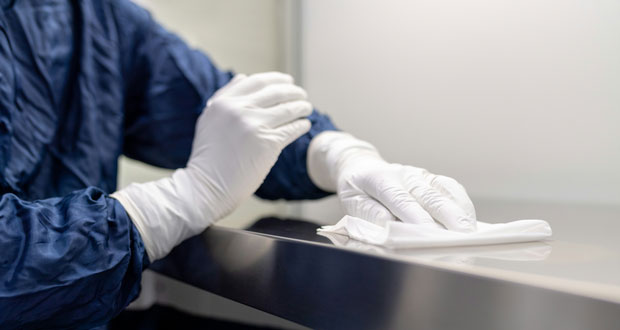
Applying pressure affects how well the wipe contacts the surface, while excessive force increases abrasion or pushes contamination around, not lifting it away. Folding is important because it creates several clean wiping faces, allowing an operator to fold a used section inward and expose a fresh surface for the next pass. Wipe direction also plays a role, as controlled, one-way strokes help move contamination away from the cleaned area rather than redistribute it.
A procedure can look consistent on paper while being inconsistent at the surface.
Pre-Saturated Wipes Solve a Different Problem Than Many People Think
Pre-saturated wipes are often discussed as a convenience product. I think that undersells their most interesting value.
Their real advantage can be control.
By combining a defined substrate with a known chemistry and saturation level, part of the operator-dependent dosing step is removed. The cleaning action becomes easier to reproduce because one variable has already been engineered into the consumable.
That doesn’t mean pre-saturated wipes are automatically right for every task. Solvent volatility, packaging constraints or task duration may also favour another approach.
The useful question is whether controlled dosing improves consistency for the specific task.
If a technician is preparing twenty identical parts for bonding, and the procedure depends on applying a reasonably consistent amount of solvent to every surface, then the quantity of chemistry reaching each component deserves as much attention as the wipe itself.
“Low Lint” Is Not a Complete Specification
A common mistake is to specify the wipe in isolation. To improve this, start with the application.
Ask the following questions. What surface is being cleaned? What contamination is present? Which chemistry removes it without damaging the substrate? How much liquid should reach the surface? How quickly does it evaporate? What level of particle or fibre release can the process tolerate? What condition must the surface reach before the next operation begins?
The wipe then becomes one element of a defined system.
This approach also exposes false economies. A cheaper wipe that needs more solvent, more passes or repeated cleaning may cost more in practice. Extra solvent consumption is visible. Lost operator time is less obvious. Rework caused by poor surface preparation is more expensive again.
The purchase price of the wipe is often the smallest number in that calculation.
ISO 14644-18 also reflects this broader way of thinking by considering cleanroom consumables in relation to product requirements, process requirements, cleanliness attributes and functional performance. That’s more useful than choosing a product simply because its description says “cleanroom compatible”.
Treat Wiping Like Any Other Controlled Process Input
The shift is conceptual.
Instead of asking whether a wipe is suitable for a cleanroom, ask whether the complete wiping process is suitable for the manufacturing outcome.
That means defining the substrate, chemistry, saturation level and wiping method together, then checking whether the combination produces a repeatable surface condition.
Sometimes the answer will still be a dry wipe and manually dispensed solvent. Sometimes it’ll be a pre-saturated system.
The important point is that those decisions should be deliberate.
In a controlled environment, the wipe isn’t something used around the manufacturing process. It’s one of the inputs that helps determine what the process produces.