
Innovating together: Bidvest Noonan and Queen’s bring smart cleaning to the Factory of the Future
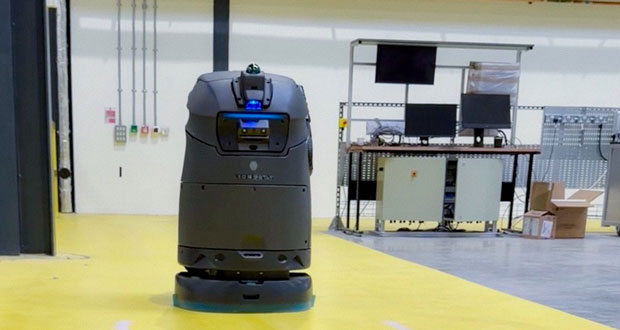
How Queen’s University Belfast and its FM partner, Bidvest Noonan, are working side by side to support people, raise standards and make FM services more sustainable at the Advanced Manufacturing Innovation Centre (AMIC).
An established partnership, taking its next step
Queen’s University Belfast’s new Advanced Manufacturing Innovation Centre at Global Point was built to show what happens when research, engineering and industry share one roof. The £100 million centre is an open-access Factory of the Future: 10,500 square metres of engineering, laboratory, cleanroom, collaboration and public space designed to push the boundaries of what manufacturing can do.
Bidvest Noonan delivers FM services across Queen’s University, and AMIC is where that long-standing partnership takes its next step. A building this advanced needs support services to match, so the two organisations have brought autonomous cleaning into the centre together, making sure the way it is looked after is as forward-looking as the work happening inside it.
Why autonomous cleaning fits AMIC
A research and innovation centre demands consistency, cleanliness and controlled environments, which is exactly where autonomous cleaning earns its place. Bidvest Noonan has deployed a fleet of cleaning cobots (collaborative robots) across AMIC to handle large, repeatable floor-care routes. The machines map their surroundings, move around the building on their own and clean to the same standard every time, so the demanding, complex spaces at AMIC get reliable coverage while the cleaning team gives its time to the detailed work that protects a facility of this calibre.
Innovation and digital transformation in practice
The real step change is the data. Every route the cobots run produces a clear record of where they cleaned, how much ground they covered and where anything got in the way. That data turns cleaning, once judged by routine and appearance, into a measurable service that Queen’s and Bidvest Noonan can review, question and improve together.
The early data from AMIC is encouraging. In one run, a cobot cleaned 300 square metres in under 40 minutes. In another, a higher-capacity machine cleaned 655 square metres in under an hour. These are real figures from the building, taken in normal working conditions.
To put that in perspective, a single cobot can cover the same floor area that would otherwise take up to four operatives to clean manually themselves. The cobots take on that heavy, repetitive groundwork, freeing the team from the most repetitive work so their time goes where it counts, on the detailed cleaning that keeps a facility like AMIC at its best.
Supporting people, not replacing them
The technology is there to support cleaning teams. Repetitive vacuuming and walk-behind scrubbing is physically demanding and time-consuming, so handing those long floor routes to a cobot gives colleagues more time for touchpoints, edges, washrooms, spot cleaning, inspection and customer-facing work. Operatives stay central to everything. They prioritise tasks, prepare and maintain the machines, respond to changing conditions and check the quality. It is a skilled role, with less of the repetition.
Consistency and quality
Autonomous routes deliver the same frequency and method every time, and every run leaves a record of what was completed. That visibility helps the team spot missed or obstructed areas, adjust maps and schedules, and put attention where it is needed. In a facility like AMIC, that consistency is part of protecting the controlled conditions the research depends on, and it is something Queen’s and Bidvest Noonan track and improve together as the data builds.
Sustainability and environmental benefits
Better data also helps the environment. Controlled routes, accurate dosing and less overlap cut unnecessary use of water, chemicals and energy, while the machines’ tank capacity and automated refill and recharge keep them working efficiently through scheduled operation.
Bidvest Noonan will measure the actual water, chemical and carbon savings at AMIC against an agreed baseline as operating data builds, because credible sustainability claims have to reflect the building’s own floor types, routes, occupancy and cleaning specification. The data from the cobots gives both partners a shared, accurate view of resource use, so savings can be targeted and proven while standards stay high.
Partnership in action
Keith Halliday, Estates Manager at Queen’s University Belfast, said: “AMIC was created to show what’s possible when research, industry and technology come together, so it is fitting that our facilities services reflect that same outlook. Bidvest Noonan has been our FM partner for some time, and at AMIC we are building on that relationship, using autonomous cleaning to support our people, strengthen consistency and generate the data we need to run this world-class facility more intelligently and sustainably.”
AMIC is the latest chapter in Queen’s and Bidvest Noonan innovating together. As the partnership learns from each route and report, the two organisations will keep refining cleaning plans, proving the environmental benefits and deciding where automation adds the most value across the estate. Bidvest Noonan continues to invest in advanced autonomous cleaning technology, working alongside Queen’s University to deliver world-class teaching, research and innovation facilities through smarter, more sustainable FM.