
Small changes, big impact: ideas into action at the TSA Autumn Conference
People, culture and collaboration set the agenda at De Vere Tortworth Court, Cotswolds, 13th and 14th October 2026
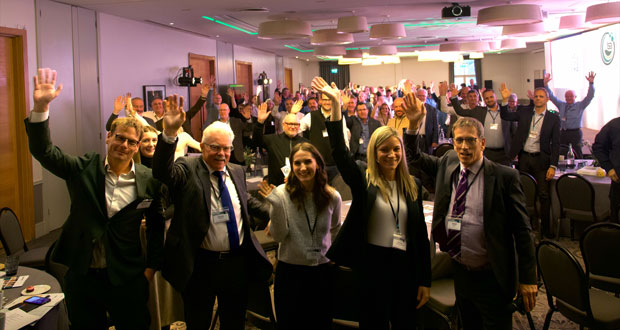
The TSA’s Autumn Conference explored how relatively small changes can make a significant difference to commercial laundries. Sustainability, safety, communication and culture were recurring themes and, as with previous years, practical advice was given through various research updates and industry debate.
The Cotswolds venue hosted two days of workshops, presentations and networking. The packed programme included personal subjects like self-promotion and neurodiversity as well as broader industry debate on hygiene, sustainable transport and the relationship between culture and company strategy. Using the Slido app live data was gathered throughout the two days to gauge the consensus of the room, and numbers were higher than ever at over 170 attendees from across the industry.
Sustainability: making progress together
Day one’s sustainability workshop, led by Mike Barry, newly appointed Co-Chair of the TSA’s Environmental Steering Group and former Director of Sustainable Business at Marks & Spencer, gave delegates an opportunity to influence the group’s priorities.
The discussion moved beyond headline targets to the practical barriers facing laundries. Electricity costs and grid capacity complicate electrification, while inconsistent product specifications and carbon data make meaningful comparisons difficult.
Textile lifecycle and longevity remains a vital topic at TSA events and was a reoccurring discussion throughout the conference, feeding into its theme of small changes, big impact. Delegates also explored carbon literacy, recycling networks and the need for suppliers, laundries and customers to work together. The workshop helped identify three priorities for the group’s next phase: energy efficiency and transition, circular textiles, and water and marine resource stewardship.
Reflecting on the seminar and the aim of the new steering group, Barry said: “This is not about TSA telling people what to do. It’s about the membership stepping forward and saying these are our priorities.”
Protecting people and businesses
Alongside the sustainability seminar were workshops on employment law, recruitment and workplace wellbeing, as well as health and safety, cyber security and hygiene. These offered opportunities to discuss industry challenges and business concerns in smaller groups.
Safety updates included the TSA’s recently launched RiskAI Manual Handling Assessment Tool, an AI-assisted service aimed at minimising workplace injuries. The TSA’s newly developed Fire Safety Audit delivered by WorkNest was also discussed. Better information and practical changes were presented as ways to strengthen prevention.
The cyber security session addressed risks, policies and Cyber Essentials, while De Montfort University’s research team contributed a biofilm update. Together, the sessions reinforced the value of addressing risks, from cyber to microorganisms, before they become incidents.
Recognition and connections
The evening provided an opportunity to network with new contacts and reconnect with colleagues. Pre-dinner drinks in the Atrium were accompanied by music from singer-songwriter Natalie Holmes, before delegates gathered for dinner.
Afterwards, TSA Certificates of Recognition were presented to Gary Youngson of Elis, Calum Tait of TDS Commercial, Laurent Maillard of Jenson UK, Ian Smithson of Kannegiesser, Richard Newton of Opeque and Karl Bueggeln of County Linen.
The presentations brought individual recognition into a conference otherwise focused on collective progress, providing a reminder that the industry’s work depends on people contributing their time and expertise.
A special shoutout was then given to Kathy Bowry, former Editor of Laundry and Cleaning News, for her years covering the industry. TSA Chief Executive David Stevens followed this with a heartfelt speech on Charlie Betteridge and his role as TSA chair. This led to standing ovation from the room.
A changing industry
The main event began the following morning, and opening his final Autumn Conference as TSA chair, Charlie Betteridge reflected on an industry navigating the instability of the times. Energy prices, inflation and supply chain disruption have changed the operating environment, while customers’ own cost-saving measures are affecting laundry volumes.
He also highlighted the TSA’s evolution, with its technical training now complemented by support covering people management, mental health and wider business challenges.
TSA Chief Executive David Stevens and Projects Director Andrew Glassford outlined current initiatives, including training, innovation and practical safety tools. The emphasis was on sharing knowledge and encouraging members to help shape the association’s work.
Small adjustments, stronger teams
Sean Liddell of Via Vita Health brought the people theme into sharp focus with a session on embracing neurodiversity.
Drawing on professional and personal experience, he explored how workplace conventions and patterns can create unnecessary barriers. Verbal instructions, competing communication channels and sensory overload can all make tasks harder than they need to be.
His practical suggestions included clearer visual instructions, simpler communication and short sensory breaks. Managers were encouraged to recognise barriers, remove friction and help people perform at their best.
Crucially, support shouldn’t wait for a formal diagnosis. Listening to individuals and making low-cost adjustments can improve the working environment for everyone, not just neurodivergent colleagues.
Research with practical relevance
Professor Katie Laird of De Montfort University updated delegates on research supporting laundry hygiene, including bioindicators used to assess decontamination performance. These provide evidence of microbial inactivation during washing, helping operators validate processes and assess changes in chemistry or technology. Consistent testing offers benefits for laundries, suppliers and customers alike.
She also discussed research into Candida auris and the importance of appropriate industrial laundering in infection control.
She concluded by examining biofilms: microbial communities that can persist within laundry systems. Early work highlighted the potential role of lint in supporting their formation, with ongoing research intended to inform control strategies and maintenance practices.
Electrification: start with the data
Royal Mail’s Head of Fleet Transformation, Stuart Murphy, shared lessons from his own experience in electrifying the company’s large, complex fleet. His advice was to understand the operation before choosing the technology.
Routes, payloads, terrain, charging opportunities and seasonal conditions all influence suitability. Rather than make assumptions, Stuart stressed the importance of trials and telematics that provide evidence to reinforce the best environmental options going forward.
Vehicle purchase is only part of the picture. Charging infrastructure, maintenance capability, driver training and total ownership costs also require attention.
Rather than waiting until every route can be electrified, businesses can identify suitable applications now, test carefully and build from there. It was another example of small change leading to big impact.
Don’t be the best-kept secret
Former BBC Business Journalist Penny Haslam challenged delegates to become a little more visible. Doing excellent work matters, but people also need to know about it.
Her session explored performance, image and exposure, encouraging delegates to share their expertise and not see visibility as showing off.
Practical starting points included speaking up in meetings, arranging short coffee conversations and contributing useful content through LinkedIn, podcasts or video. Authentic, helpful communication doesn’t need to be expensive and leaders can strengthen their businesses by supporting a wider range of employee voices.
“Penny’s presentation really made me think we should be doing more video content,” said Joy Amory, HR Director of Johnson’s Hotel, Restaurant and Catering Linen. “We should be putting ourselves out there… faces behind the big name of Johnson’s!”
Is culture supporting strategy?
Adrian Walcott and Martin Roach of Brands With Values used a conference culture study to explore the sector’s strengths and constraints.
Tradition, safety and success featured strongly. However, the findings also raised questions about curiosity, collaboration and whether people feel able to challenge established approaches.
An industry panel featuring Kevin Godley, CEO of CLEAN, Mark Franklin, CEO of Elis UK, and Simon Fry, Chair of Micronclean, examined the operational realities behind those themes.
Think bigger, act now
Drawing on his experience sailing around the world, Caspar Craven’s keynote explored the relationship between an ocean voyage and working within a business. Bold ambitions are important, but many get overwhelmed by the bigger picture. Tying to the key theme of the conference, Craven looked at breaking challenges into smaller stages that ultimately lead to a bigger impact. By questioning assumptions and allowing for room to experiment, teams can move forward without waiting for the perfect conditions.
TSA Managing Director Emma Kiviniemi Wilson brought the focus back to the industry’s wider importance, outlining public affairs work and encouraging members to engage MPs through site visits.
“We’re so thrilled by the response to this year’s conference,” says Emma. “I think culture has been a huge point of focus. From neurodiversity to self-promotion, we’ve seen how small steps can make a big impact. By bringing in speakers outside our sector too, they often comment on how important we are to the economy as a whole, but also how friendly we are as group. The conference is great opportunity for us to celebrate this together!”