Preventing reputational and health risks in commercial kitchens
 By Jamie Woodhall, UK Technical and Innovations Manager at Rentokil Specialist Hygiene
Commercial kitchens are hives of activity. They are fast-paced environments, where teams work hard to deliver great food on tight schedules. In such a busy setting, health and safety risks can inadvertently be overlooked, but be aware that if they are left unaddressed for too long they could become real fire incidents or failed food safety inspections.
The London Fire Brigade has linked a number of recent fires across the capital directly to commercial kitchen operations, while the government’s records count 1,917 fires in food and drink premises in England during 2023/24. For these businesses, the financial costs are severe, with the average cost of a major fire incident reaching approximately £657,074.
Separately, data published between 2019/20 and 2023/24 also found an annual average of 2,133 food safety incidents in the UK. This includes allergen contamination, physical hazards like foreign objects and chemical residues. These figures highlight the need for specialist deep cleans and robust hygiene protocols.
As we head into the festive season which is one of the busiest times for hospitality, managers must treat health and safety policies as a priority. Regular deep cleaning, thorough maintenance, and consistent staff training not only reduces the likelihood of both fire risks and the potential for food safety incidents to occur, but also protects staff, customers, and the business’s reputation.
Mitigating fire risk from grease build up in ventilation systems
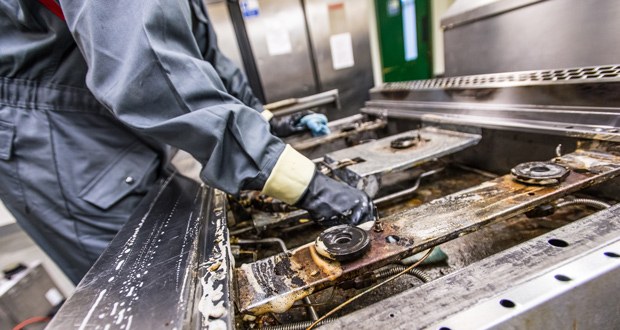
Even the most well-run kitchens can fall victim to preventable fires. One of the most common causes is grease accumulation in ventilation systems, with 70% of all commercial kitchen fires originating in these systems.
When cooking with oils and fats, vapours carry microscopic grease particles. Over time, these particles condense and form thick layers of highly flammable residue on the inner surfaces of hoods, ducts, and fans. These grease layers can ignite from even a small spark, causing fires that spread rapidly.
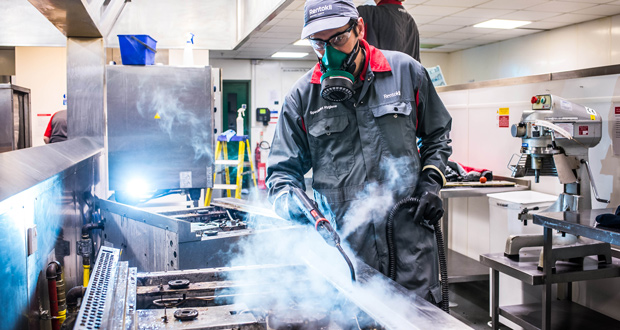
To reduce this risk, in line with a restaurant’s service demand, we recommend scheduling professional maintenance on a regular, bespoke basis, at least every six months. This should include a thorough degreasing of all ductwork using mechanical or chemical methods, and a clean of the fan blades to maintain airflow and prevent overheating. An inspection of mesh or baffle filters should also be undertaken as these can trap grease and oil. It is also important to ensure a regular professional deep clean of the entire commercial kitchen.
Taking a systematic, top-to-bottom approach in order to remove stubborn grease, disinfect every surface and eliminate unseen pathogens. Using industry leading tools and food-safe agents, these services also support pest prevention and can be scheduled to minimise disruption to operations, ensuring compliance with Kitchen Grease TR19 Ventilation Cleaning guidelines.
Regular, scheduled professional cleans are not enough on their own, and must be combined with daily hygiene routines to help ensure that flammable grease residues do not accumulate to dangerous levels.
Safeguarding public health through hygiene
Beyond critical fire risks, maintaining rigorous hygiene in commercial kitchens is essential to protect public health, ensure regulatory compliance, and maintain operational continuity. Around 26% of reported food safety incidents in the UK involve pathogenic microorganisms such as E. coli, Listeria, and Salmonella, linked to foodborne illness outbreaks in commercial kitchens.
Residues and improper handling can harbour harmful bacteria, making even small hygiene lapses potentially dangerous. Common mistakes include incorrect food storage, inadequate handwashing, and the failure to regularly change or sanitise tea towels. Government reports indicate that poor cleaning habits remain widespread, underlining the need for structured hygiene management.
Recognising safety hazards regulations such as Food Safety Act 1990, Hazard Analysis and Critical Control Point (HACCP) system and Food Standards Agency (FSA) Standards is paramount. These regulations form the focus areas for Environmental Health Officers which typically inspect chemical, microbiological, and physical hazards, assessing everything from chemical storage to cross contamination, surface sanitation, and equipment maintenance.
From awareness to action, building a culture of kitchen safety
The cost of inaction in commercial kitchens far outweighs the investment required for proper prevention measures. As both the London Fire Brigade and the UK’s Food Security report highlights, the unseen dangers of grease accumulation and poor hygiene remain among the most significant challenges for those working in the sector. By implementing regular deep cleans alongside daily hygiene routines, those managing commercial kitchens can significantly reduce the risk of failed inspections. A clean and well-maintained kitchen is not just about appearances, it is about safeguarding lives, protecting public health, and ensuring operational continuity.